

TIDAL Cracks Down on AI-Generated Music: What Every Artist Needs to Know
TIDAL AI-generated music is changing the conversation across the music industry. The streaming platform has introduced a new policy that removes royalties for fully AI-generated songs while increasing transparency for listeners. The move has artists, producers, DJs, and record labels asking what this means for the future of streaming and music creation.
Why TIDAL Is Taking Action Against AI Music
Over the last year, AI music generators have exploded in popularity. Anyone can now type a few prompts into software and generate songs that sound surprisingly close to professional recordings.
While AI has opened new creative possibilities, it has also created serious problems.
Some creators have uploaded thousands of AI-generated songs in hopes of collecting streaming royalties. Others have used AI to imitate famous artists without permission, confusing listeners and potentially diverting income from real musicians.
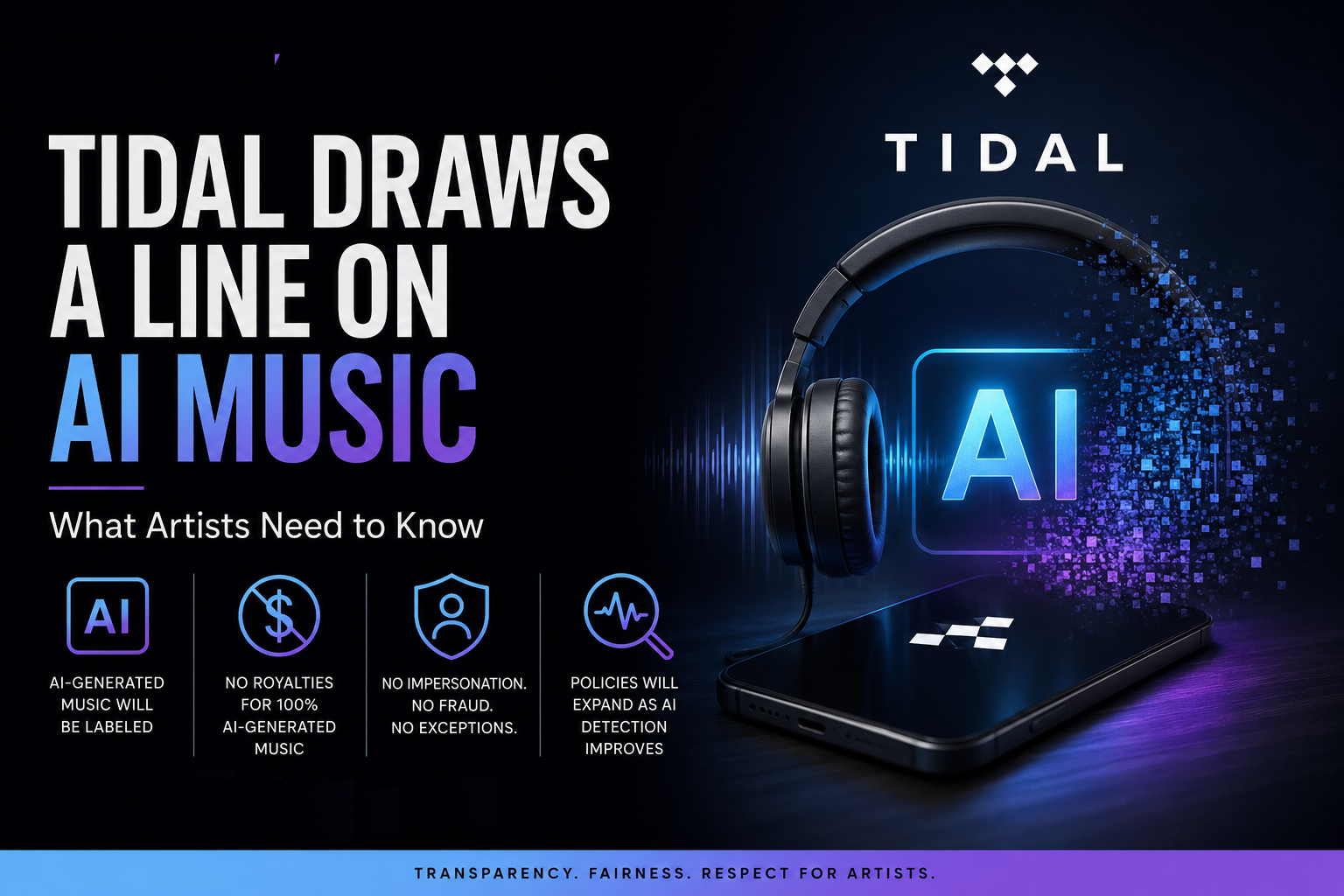
TIDAL says its new policy is designed to protect human creativity while giving listeners more transparency.
Beginning immediately, tracks identified as entirely AI-generated are no longer eligible to earn royalties. Starting in mid-July, those tracks will also receive a visible AI label inside the platform.
What the New TIDAL AI Policy Includes
TIDAL’s policy goes beyond simply removing royalties.
Here are the biggest changes:
- Fully AI-generated music will not receive streaming royalties.
- AI-generated tracks will receive clear labels for listeners.
- Music that impersonates real artists will be removed or blocked.
- Fraudulent AI uploads designed to manipulate streams will be taken down.
- As AI detection improves, TIDAL plans to identify songs that are substantially AI-generated—not just those created entirely by artificial intelligence.
The company says its goal isn’t to stop innovation.
Instead, it’s trying to preserve fairness for artists who spend years developing their craft.
What This Means for Independent Artists
Independent musicians may actually benefit the most from these changes.
For years, streaming platforms have struggled with fake streams, bot accounts, and low-quality uploads flooding recommendation systems.
Now imagine millions of AI-generated songs competing against independent artists for playlist placement.
That’s a real concern.
If AI-generated content continues to grow unchecked, it becomes harder for genuine artists to get discovered.
By removing royalty incentives for fully AI-created music, TIDAL is attempting to reduce what many creators call “AI spam.”
That could create a healthier environment where original music has a better chance to reach listeners.
AI Isn’t Going Away
Let’s be honest.
Artificial intelligence isn’t disappearing.
Artists already use AI for:
- songwriting ideas
- mastering assistance
- vocal cleanup
- production tools
- lyric brainstorming
- mixing suggestions
Those tools aren’t necessarily replacing artists.
They’re assisting artists.
The bigger question becomes:
Where should the line be drawn between AI assistance and AI creation?
That’s the challenge every streaming service, record label, and copyright office is now trying to answer.
My Take: The Industry Needed This Conversation
As DJ Ms. Hypnotique, I believe technology should help creativity—not replace it.
AI can become another instrument inside the studio.
But when software starts earning royalties intended for human creators or impersonating real artists, the industry has a responsibility to respond.
TIDAL’s new policy won’t solve every problem surrounding artificial intelligence, but it sends a powerful message:
Music still has value because people create it.
The emotion behind a lyric.
The life experience inside a verse.
The imperfections that make a performance unforgettable.
Those are things technology still can’t truly replicate.
The music business is entering a new chapter, and every artist—from independent creators to major-label stars—will need to understand how AI fits into their future.
One thing is certain:
The conversation around AI-generated music is only getting louder.
Final Thoughts
TIDAL’s decision marks one of the clearest statements yet from a major streaming platform on the future of AI-generated music. By removing royalties for fully AI-created songs, labeling AI content, and cracking down on fraudulent uploads, the company is prioritizing transparency and protecting artists from abuse.
Whether other streaming services adopt similar policies remains to be seen, but one thing is undeniable: the music industry is changing rapidly.
For artists, producers, DJs, and fans alike, staying informed may become just as important as staying creative.
Because the future of music won’t simply be about what sounds good.
It will also be about who—or what—created it.